
June Notebook

First, four books to understand America:


On a more traditional note, I very much enjoyed Brad Skow’s poetic rendering of the events leading up to the Declaration (and this excellent review of the book).

Does Obesity Stigma Cost Lives?
A recent paper argues that stigma against the obese increases in-hospital mortality,
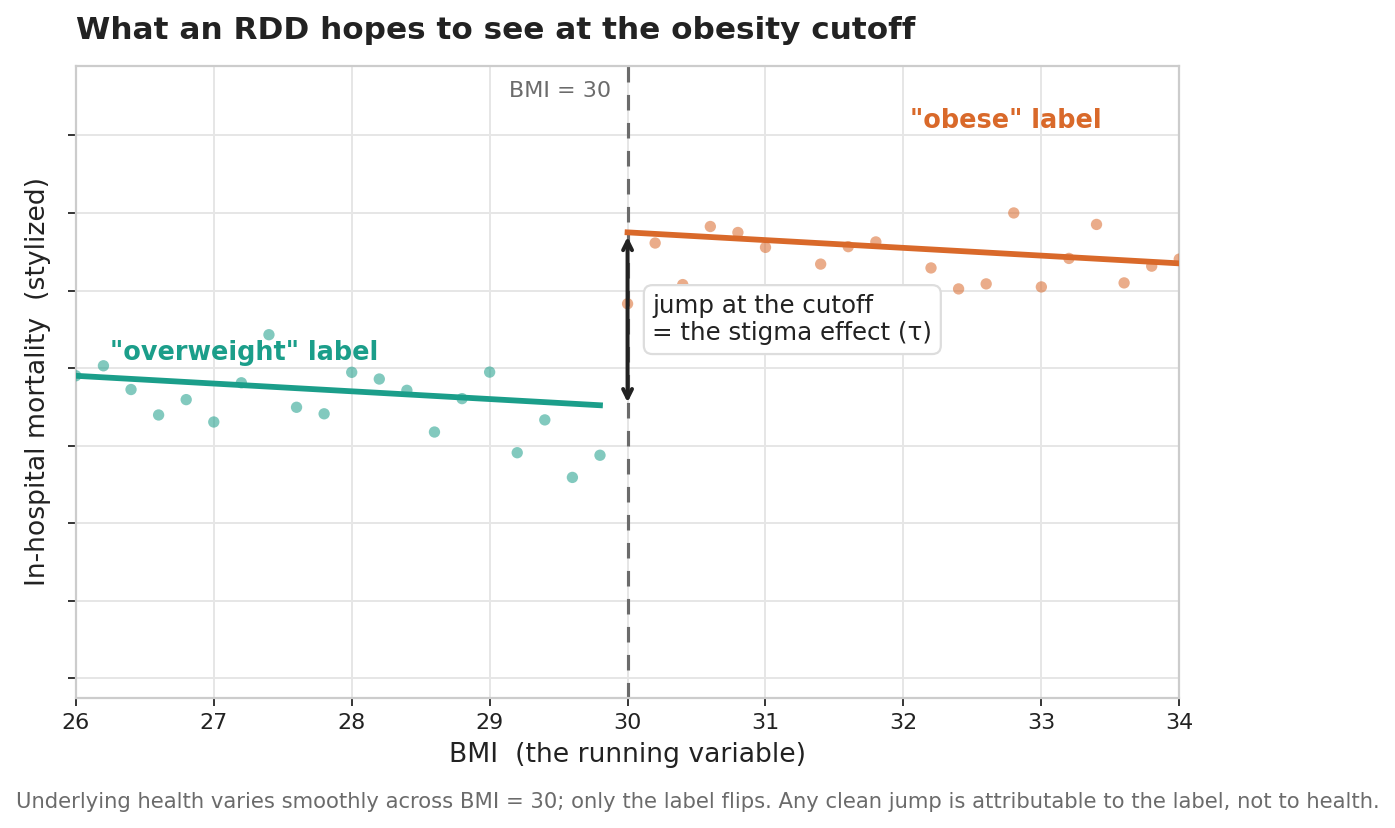
BMI categories are displayed prominently to providers in electronic medical records, and obesity is heavily stigmatized socially. Thus, at the “obese” cutoff, stigma may shift discretely while the underlying trait (BMI) does not. Using a regression discontinuity design that exploits this institutional feature, I find a discontinuous increase in in-hospital mortality at this cutoff, though patient health does not change.1
RDD relies on the assumption that the only abrupt difference between a person just below BMI 30 and a person just above BMI 30 is that the latter is considered “obese”. Since the cutoff is arbitrary, any such difference observed between the two edge cases can be attributed to group membership itself as opposed to other confounding factors.
Here is a stylized example of what this might look like in the simplest case:
This type of strategy goes wrong when study subjects partly choose which side of the cutoff they end up on. In the worst case, this sorting results in a group of relatively healthy borderline obese people on the left of the line and a group consisting of people who can’t bring their weight down (or don’t care to) on the right side.
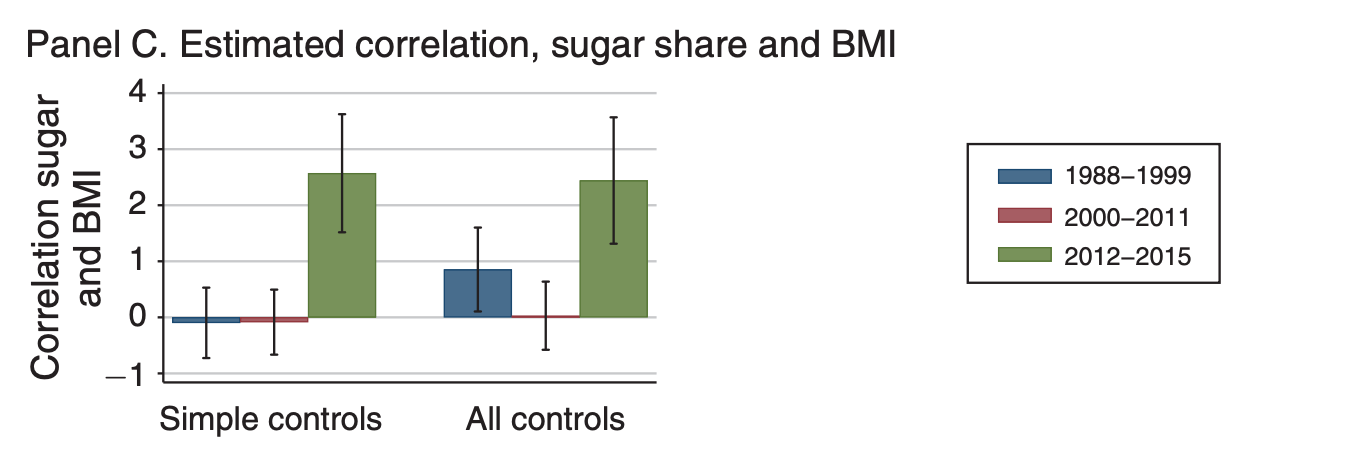
Emily Oster has demonstrated the importance of this kind of health-conscious self-selection by looking at what happens when health authorities change their recommendations. When the US Dietary Guidelines first mentioned avoiding sugar for health reasons in 2000, there was little to no relationship between eating sugar and exercise or smoking. But over time, these behaviors predicted sugar consumption as individuals selectively responded to the recommendations, in line with their pre-existing traits.
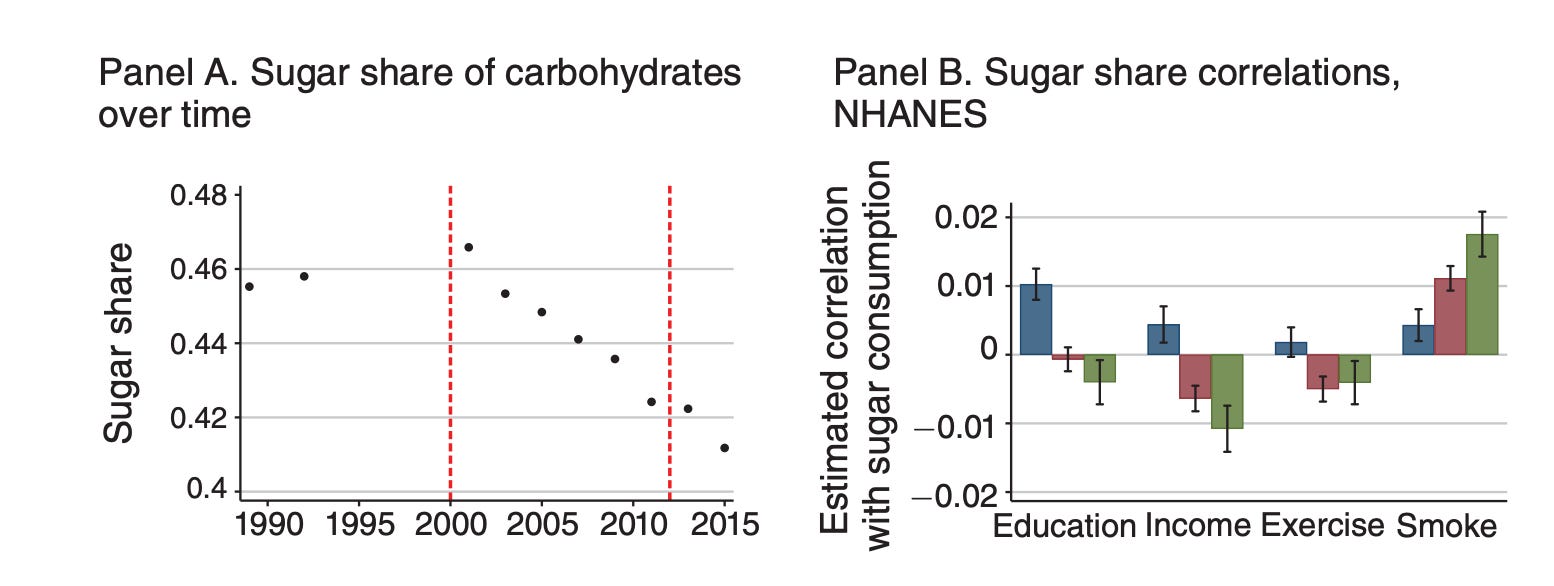
Oster’s findings suggest that some people are more committed to knowing about medical guidance than others and take to heart the stated guidelines.2 Given this, we might expect the designation of BMI 30 as the threshold for obesity to influence where someone on the border of the two categories ultimately ends up, even if the practical difference in health brought about by BMI difference in and of itself is not ultimately large.
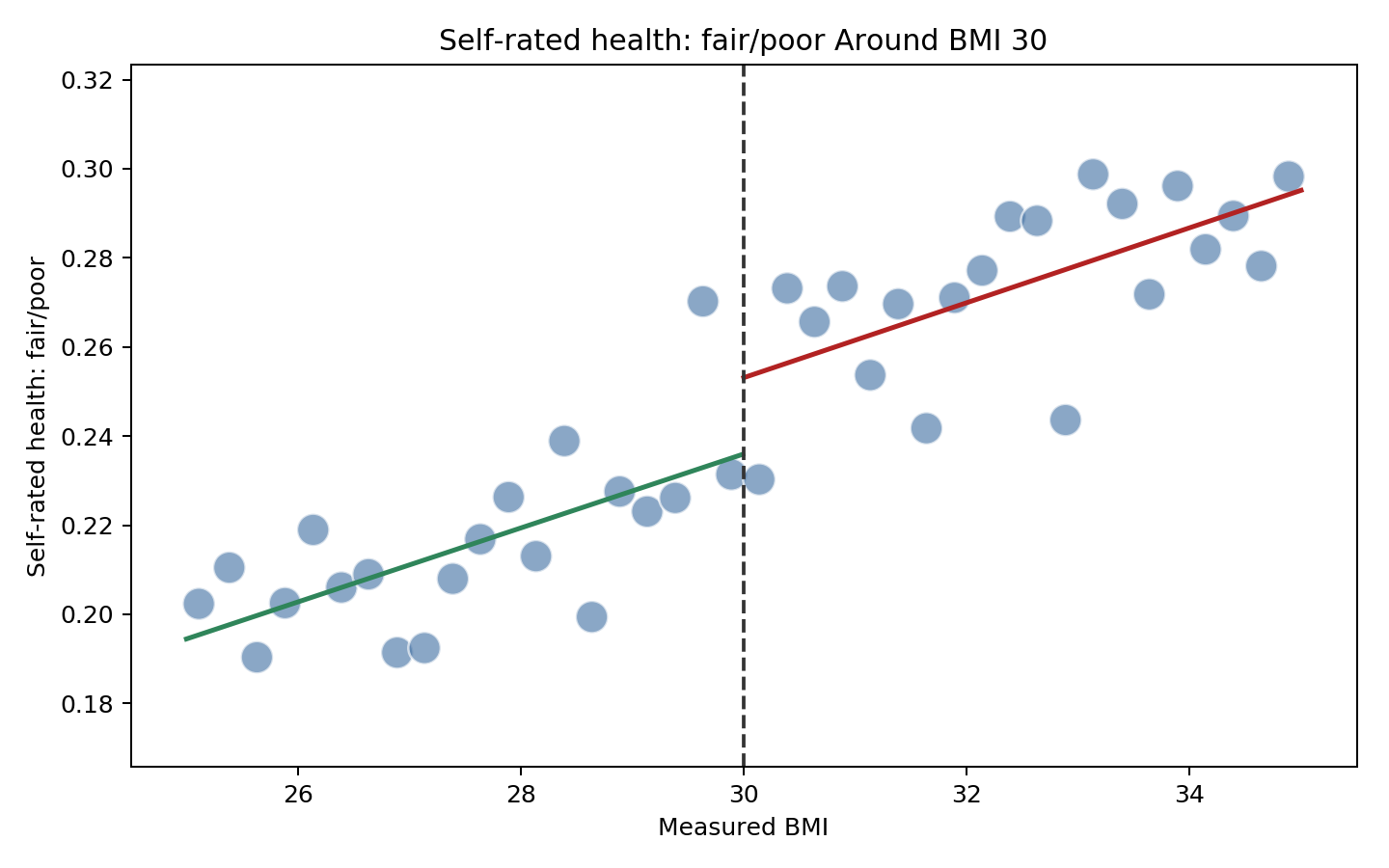
I’m not overly invested in proving this theory explains the stigma result, in part because it’s hard for me to envision sufficiently good data to disprove that people just outside the obese category are partially there by choice. Most selection takes place on the basis of unobservables.3 But by one measure at least, people seem to believe it themselves.
Does Corn Dramatically Inflate Your Grocery Bill?
In a similar vein,

The primary cost here is simply that turning corn into gasoline makes food more expensive.
A 2013 paper by Michael Roberts and Wolfram Schlenker with the boring title “Identifying Supply and Demand Elasticities of Agricultural Commodities” has a fairly striking conclusion. The authors look at past shocks to agricultural commodity supplies — including corn, wheat, rice, and soybeans — and they show that the prices of these things are linked. If wheat crops fail somewhere, this raises the price of all four crops because people are substituting. As a result, mandating that American oil refiners turn corn into gasoline raises the global price of rice, as well as the global price of corn.
The authors concluded that the then-current version of the biofuels mandate was raising the global price of food by between 20–30 percent.
The exact number may be different today than it was in 2013 because the world is always changing. But the direction is unquestionably the same.
Requiring ethanol in gasoline is indeed a dumb policy. But it probably does very little to increase the price you personally pay for groceries.
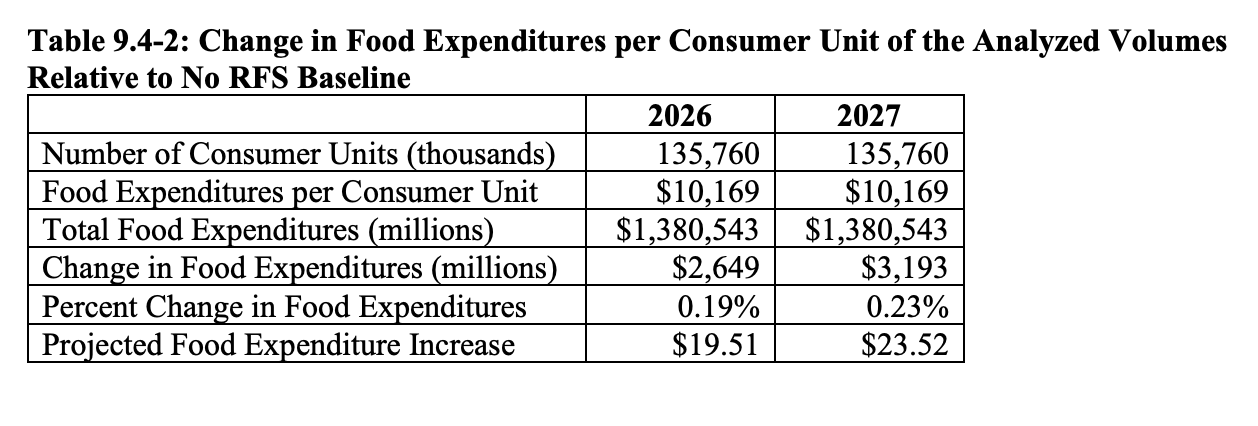
The staple crops Matt listed did rise in price 20-30% according to the referenced study, but those are raw staple commodities, not retail food prices. In rich countries, they make up only a small portion of the final price consumers pay for food. In the U.S., the impact is likely on the order of a few dollars per month.
Corporate Loves Growth Mindset
In at least this respect, Neil Irwin confirms that my job search was representative-
Carol Dweck, the Stanford University psychologist, wrote in her 2006 book Mindset of the importance of a “growth mindset,” which she contrasts with a “fixed mindset.” It is a concept that came up in more than a few of my interviews with senior executives more than a decade later. In effect, what I saw over and over was that this growth mindset was a necessary precondition for the people who would go on to acquire the specific mixes of skills that have enabled them to thrive in the modern corporate world. It’s Dweck’s growth mindset that results in a person having a three-year itch whenever they’re getting too comfortable in a job, which causes them to think of their career as a series of tours of duty4
I was surprised and, at points, quite irritated to see corporate culture so dominated by this concept. There were times after networking calls where I wanted to scream: Growth mindset doesn’t even replicate!
But I’m starting to come around to the possibility that these executives are onto something. Leaving aside the question of whether you can boost test scores in the classroom, there are a number of ways growth mindset arguably leads managers to make better decisions.
Dweck-pilled managers:
Invest in employee development
Give corrective feedback rather than writing people off
Hire for potential rather than only credentials
Encourage experimentation and learning from mistakes
Given that elite companies have the luxury of being able to filter for highly capable people, their failure mode is not overestimating employees’ potential, but underestimating how much they can improve. By making growth mindset a pillar of their corporate cultures, executives send out the bat signal to workers with a drive for self-improvement and commit to reward their progress as it manifests over the long-term.
Much as it pains me to admit, Growth Mindset appears to pass the market test. Dismiss it at your peril.
Other Things Worth Reading
1. “Tyler Cowen: talent, effective altruism and religion”, w/ Salvador Duarte
I don’t know, again, if you look at the talent in the EA movement, I would say a lot of it is highly analytical. And as talents, they’re not that strong in the humanities. It’s just an observational fact. So maybe they’re better off just sticking with the analytic stuff. And someone else will have to do the cultural and religious issues. But still, you’d like if there could be more crossover, right, in both directions. But maybe they’re just not good at it. Like some of the EA people, you talk to them, they just seem like they’re in quite a fog, they grew up in the rationality community. They’re very good at a certain, very narrow set of ways of thinking. They can be very effective applying those ways of thinking. Maybe that’s just their comparative advantage.
They also discuss which books (Dante, Canterbury Tales) and people (Elon) will be remembered in 1000 years. I think they missed one!
2. “An infovore shares his chats”
More Tyler, on his favorite use cases for ChatGPT Pro.
3. “Who’s looking out for passive investors?” by Hanno Lustig
If index providers start adding hidden fees to index funds by stuffing the index with overvalued stocks that haven’t seen real price discovery, the case for passive investing will inevitably become less compelling. Passive investing might become like flying on Ryanair, where you show up at the airport with your dirt cheap ticket and all of a sudden you get hit by a wave of fees you didn’t expect.
Obviously topical with SpaceX, other mega IPOs coming down the pipe soon.
4. Brad Skow reviews “Selfish Shallow and Self-Absorbed”:

He incorporates many good excerpts from the book.

5.

In the early days of ChatGPT I made predictions for what traits will win in the age of AI. Neuroticism ranked high on my list!

6. The Rehearsal, S1 episode 1 (HBO)
Nathan Fielder helps a New Yorker prepare to admit a long-hidden lie to a friend. To reduce the uncertainty of the confession, Nathan constructs an elaborate practice environment with actors, replicas, and repeated simulations, turning a simple social dilemma into a strange, meticulous experiment.
7. “The Premarital Sex Revolution” by Arnold Kling
I don’t think we realize the consequences of the sudden shift from treating premarital sex as wrong to treating it as normal. I think we took away from dating much of the romance, fun, amusement, and buildup of sexual tension.
Young men used to assume that doing without sex was something that all unmarried men had to accept. Now, those who do not have opportunities for sex must take it personally.
In the old days, young women who disliked casual sex had an easy way to say “no.” They could agree to go out on a date without treating this as tantamount to agreeing to have sex. As saying “no” becomes more difficult, they say “yes” and regret it, acquiring and spreading negative attitudes about men.
Of course many women simply turn down dates to avoid this situation.
8. Rick Rubin enjoys the destination, not the journey
9.

Skepticism of the earlier paper notwithstanding, I am not entirely shocked by these results. Living through the pandemic opened my eyes to “lookism” and how strongly looks affect how we perceive ourselves and others.
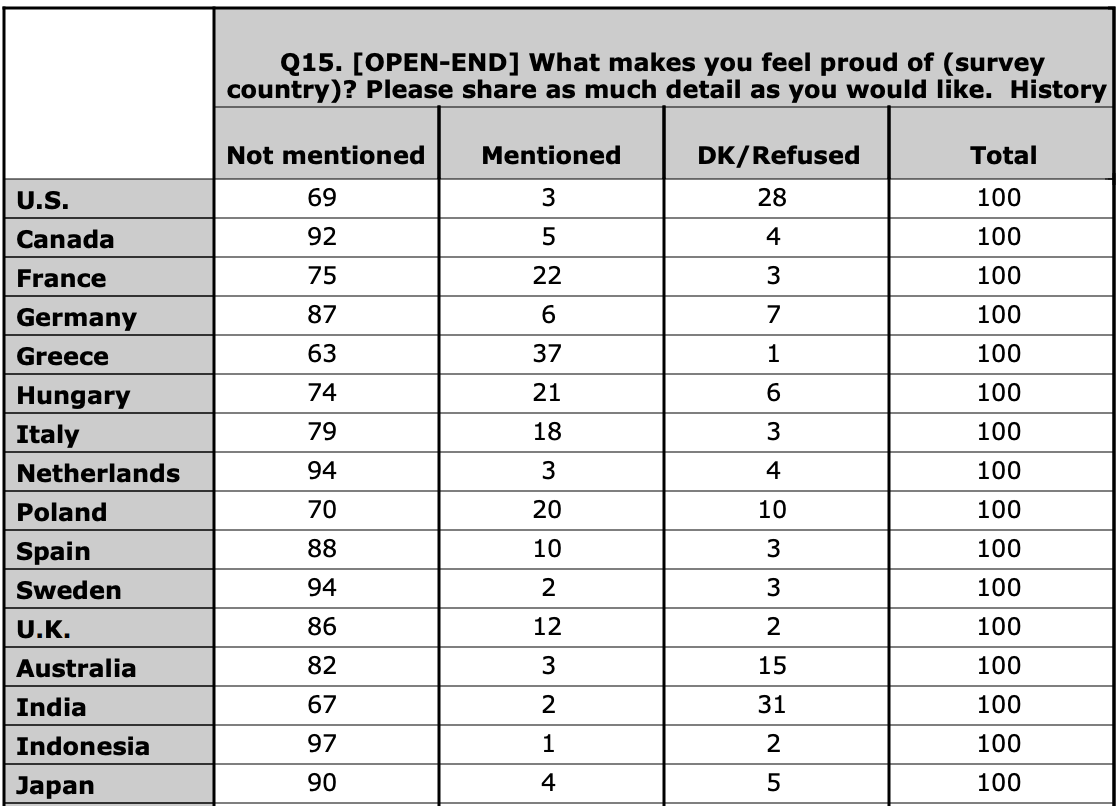
10. Just three percent of Americans mention history as a reason they are proud of their country, fewer than Italy, Japan, and Germany.
Have a Happy Fourth of July!
“Deadly Stigma” by Manasvini Singh
See “Health Recommendations and Selection in Health Behaviors” (Oster 2020), which also looks at self-sorting that followed changes in recommendations with respect to Vitamin E, Vitamin D, fat consumption, and the Mediterranean diet. Working paper version is here.
“Panel C shows the regressions including controls and demonstrates that the patterns persist.” (Oster). The y-axis label refers to regression coefficients which indicate that a higher sugar consumption as a share of total carbs is strongly associated with a several point increase in BMI.
From Neil Irwin, How to Win in a Winner-Take-All World
I’m curious how many people who recommend Growth Mindset actually read it. This would be a major wrinkle in the market testing idea. Maybe it works best as an idea and secondarily as a book.
I kind of wonder about the BMI thing. People usually follow their weight, not their BMI, because most people don't like math. So if anything I'd expect to see cutoffs at round numbers like 180, 190, and in particular 200...